|
History of Our
Neighborhood
* This History
was prepared by Larry Miller in April, 2011 as part of the
neighborhood's application to become a new historic district.
A History of the Heights


Early years- to 1900
In the late 1700s northeast Reading was a rather distant suburb
of the town of Reading. It was not yet a part of Reading; that
didn’t happen until 1850.
Reading had only recently (1783) become a borough and contained
about 2,000 people, nine tenths of whom were from German stock. Most
families resided along or near the main artery, Penn Street and the
two blocks extending east and west although small settlements
cropped up in areas removed from the center of town. A few of these
areas were named for the landowners as was the case with Ricktown in
the northwest, named after Charles Rick and Helltown in the
northeast, named after the tavern keeper, John Hell. This area was
roughly bounded by 11th Street (the outer limit of the
town), Hampden Park, Marion and Spring Streets.
Helltown itself had only a few log and stone
houses, the oldest of which stood near the intersection of Hampden
and Marion streets (around 1134 Hampden Blvd.) owned by Samuel
Katzenmoyer.
John Hell was
one of the first settlers to recognize the potential of living in
the northeastern outskirts of the Reading. Although he was aware
that there were plenty of lots remaining for sale in the town, the
northeast section offered cheap farmland accessible to the market.
It also offered drinkable water, a scarce commodity in the town
itself, coming from "an inexhaustible spring" commonly called
Hampden Spring. The Spring probably was named to honor John Hampden,
an English patriot and ancestor to William Penn, who visited America
in 1623 in search of land
Although shallow wells were common in Reading, the entire area is
riddled with limestone deposits which cause the water to be hard and
not very palatable. But at the head of Penn Street there was a
deeper spring with enough flow to supply the town. Here the early
residents constructed a reservoir of stone and enclosed in with a
windowless frame structure with one door. Through a crude system of
wooden pipes, the water flowed down to Penn Street with the overflow
channeled to 11th Street. For many years, this spring was
the primary source of fresh, soft water which was extensively used
to wash cloths.
Although
necessary for cooking and washing, water was not the preferred drink
of everyday life, alcohol was. Part of the appeal for alcoholic
beverages was that water was considered unsafe, a drink better
suited to barnyard animals than humans. Because there were no
sewers, the water in towns, villages and cities was far more
polluted than is today. Around the time Reading was established, the
Pennsylvania Gazette reported on a series of disasters that had
befallen individuals as a result of drinking water. One laborer “was
thought to have died, had not a person present forced a quantity of
rum down his throat, by which means he soon recovered.” So, by 1773
there was one tavern, brewery or store selling liquor for every nine
residents in the town. Even the jail had a tavern license. Liquor
was sold there from 1805 until 1809. George Phillippi, “a blind,
aged and respected citizen who resides on Franklin above 9th”
when he was interviewed in 1873, recalled a time when the children
used to meet at the jail yard and play ball there, while the
prisoners played cards in their cells on the second floor of the
building. When the young men became thirsty, they went into the
barroom and drank. After the tavern was closed the prisoners secured
whiskey by hanging strings through the iron grated windows and
friends tied bottles filled with liquor to the strings and these
were pulled up and the prisoners occasionally became greatly
intoxicated.” Reading was not alone in their love of alcohol. The
year 1830 marked the highpoint for alcohol consumption in the United
States. On average, 90 fifths of 80 proof alcohol were drunk by
every man, woman and child over the age of 15 per year.
It was a rather
long walk from John Hell’s tavern to the taverns closer to the
square and for the traveler heading east out of town, the trip to
the next tavern was even longer, so it’s likely that John Hell’s
place never suffered from a lack of patronage. In addition to
travelers and merchants, John also catered to the town folk who made
the area a popular place to picnic, celebrate and entertain. It had
the cold springs, the cool mountain air, a great view from the
clearings in the woods, and was an easy walk to and from town.
But over time,
Hampden Spring itself became the primary attraction as it became a
gathering place for the early settlers to obtain fresh water for
themselves and their horses.
Farmers and
merchants were also quick to recognize the potential of the area. In
addition to the springs which could provide water for their
livestock, Helltown also had a road of sorts called appropriately,
the Helltown Road. It ran east and west and, in reality, it was not
much more than a widened dirt trail, that ran past the base of the
springs. From the springs to Penn street was about a mile, so over
the years the road became a well-used path into the center of the
city. Even before the turn of the century, farmers and merchants
coming into town along “the road to Pricetown” would drive their
wagons from New Jerusalem and other surrounding communities, stop at
the springs to water their horses, and continue into the Reading to
sell their goods—and get a drink at any of a dozen taverns. On
market days as many as 25 wagons would rumble past on their way into
and out of Reading. John Hell decided that this would be an ideal
site to build a house, in fact two houses. He lived in one and sold
the other to newlyweds Adam and Elizabeth Harbold. The Harbold
family lived in the log home until 1811 when they bought 18 acres of
meadowlands fronting Helltown Road on the slope of Mt. Penn. It
turned out to be the most valuable parcel of land in the area
because on it was located Hampden Springs. Near the site where today
stands the Water Company building that faces Hampden Boulevard, Adam
and Elizabeth built a one story stone house and a small conical
shaped cabin to enclose and protect the spring. Adam was
quite generous in sharing his water with the locals and gave them
permission to walk through his property to reach the spring that was
located about a hundred yards from the street. Eventually and with
his own money, Harbold laid wooden pipes from the spring down to the
street where it entered a trough which had two sections: one for
horses and one for people. He charged his neighbors $1 yearly for
the unlimited access to the spring water. Most gladly paid, since
the alternative was walking over a mile to Penn Commons to use that
spring. A huge willow tree, which had taken a liking to the damp
area where the spring met the Helltown Road, covered the watering
spot. According to local yore, a neighbor nailed a painted white
board with the name Hampden in black letters.
As Reading grew, it became apparent that the spring on Penn’s
Commons would not satisfy the demands of the increasing population
and the city fathers began to explore the possibilities of bringing
other springs into the town. One of the places they turned to was
nearby Hampden Springs. But Adam had no interest in selling his farm
so his neighbor, John Miller, an influential attorney with close
ties to the newly formed Water Commission decided to try a different
approach.
Miller was a man of many occupations. He was a
sheriff, ran a tavern on the west side of North 5th
Street, and farmed his land which he had purchased in 1807. In his
first two occupations he was in the enviable position of being “in
the know”. Taverns were the centers of activity in Reading. Most
were quite small, not much larger than an average living room and
indeed many of them were just that. Churches and taverns brought
people together, churches once or perhaps twice a week; taverns,
almost daily. And unlike churches, men of all denominations were
welcome. Here dances were held weekly and, to avoid conflict, the
tavern owners had an agreement to rotate the location. But most
importantly, taverns were centers of communication. This is where
men from all walks of life met to exchange news and gossip. Here
properties were bought and sold here and sheriff’s sales conducted.
For most people, a visit to the tavern was part of their everyday
routine. So as both sheriff and tavern owner in a town of 4,000 men
women and children, probably less than a thousand households, there
wasn’t a lot that went on that John Miller wasn’t aware of.
Around this time, 1810-1815, there was much
talk about forming a water company to deal with the problem of
delivering drinking water to the growing population.
John Miller approached Harbold asking him if he
could have permission to “dig out a spring” on Harbold’s land.
Harbold, always a generous man, gave him permission but soon after
Miller complained that the amount of water he was getting wasn’t
“sufficient for his intended purpose.” Now, in 1818, the two men
agreed that for the sum of $25 Miller would have “all the full right
to the Spring already dug with the privilege of leading the water
across Harbold’s land to the adjoining land of Miller and with the
right to dig for water at any place along the eastern fence of the
meadow ground and lead the water into the spring and to conduct the
water in pipes. In return, Miller “is to allow the said Harbold as
much water as he hath need for family use” and he retains ownership
of the two acres of land on which the spring was located. Harbold
got to keep his farm but John Miller now had control of the water
rights to the spring.
When the Reading Water Company was formed in
1819, it was John Miller’s 40 acres that they bought first for
$1,500. In addition Miller added a clause to the deed stating that
the owner retained the right to take “as much water as may be
necessary” from the spring. (Almost a hundred years later, the city
sued the owners of properties located at 126 N. 5th
Street, which at that time was the site of the Reading Automotive
Company, for delinquent water bills. It seems that Miller had owned
the property since 1807 and, after he sold the Hampden spring to the
Water Company, he was entitled to receive free water and so was
every subsequent owner of the property. The city lost the suit.)
Harbold, right up until the day he sold his land, continued to
maintain the spring and when the structure protecting it was
destroyed by a storm blown tree limb, he replaced it with a stone
shelter. After the water company took over, they built a stone
springhouse and placed a hydrant where the trough stood, both
remained for over a century.
On Oct 26, 1822 the Berks and Schuylkill
Journal reported, “The citizens of Reading ought to rejoice at the
prospect of being in a short time supplied with the purest water
from a never-failing source. The operations of the Reading Water
Company warrant the assertion that before winter visits us, at
least 300 families may, if they think proper, have fountains in
their houses sufficiently copious for any purpose desired.” Yet, for
many years after the Reading Water Company brought fresh water into
the yards of its customers, many households continued to use the
water they pumped from shallow limestone wells. There were about a
hundred of them in daily use and they could be easily accessed on
just about every block in the city. And on “wash day” dozens of
women continued to gather at the head of Washington Street boiling
the water from the stream that flowed from the Commons, in large
iron kettles. The cleaned clothes would then be hung on lines or
laid on the grassy areas where they would be dried and bleached by
the sun. This custom continued until well after the grading of the
streets in 1832.
Another early and important settler to the area
was Ludwig Katzenmoyer. He and his second wife, Elizabeth, lived on
a 60-acre farm near the present day 11th and Marion
Streets which he bought in 1801. He was born in 1758, the son of a
German immigrant Peter, who settled in Exeter Township shortly after
his arrival in this country. Ludwig and his family had moved here
from Cumru Township. Over his 82 years, Ludwig survived several
wives, fought in the Revolutionary War and had at least thirteen
children.
When he was well into his 70s, Ludwig turned
the farm over to two of his sons, John and Jacob and retired from
farming. In 1826 he built a two story stone home on a ¾-acre parcel
of land with a “tavern stand” which, in 1832, he sold to Charles and
Mary Clay. After Charles death in 1857, the property was taken over
by John Clay and later, in 1864, Jacob Bischoff bought the property
and enlarged it. For over fifty years, his hotel was the only one in
the northeast and was the social center for the area. On a map from
1884, as well as in the City Directory, the hotel is listed as being
located at 942 Hampden Boulevard. Today the location is a traffic
island at the intersection of Hampden Boulevard and Spring Street.
(There was only one other hotel in Northeast Reading, the “Hampden
Park Hotel”, which didn’t exist until the turn of the century. It
was located at 1263 North 13th street, now the site of
Northeast Junior High, and operated by Augustus Bulles the son of a
German immigrant who lived in Philadelphia. It was not a large hotel
and could accommodate but five or six guests.)
After the sale of the tavern, Ludwig
Katzenmoyer built a house on the land where the Hampden reservoir
was located. An old newspaper account describes it as “a very
peculiarly built dwelling.” It was here in this one story stone
house that Ludwig, a member of the First Reformed Church, organized
the first union Sunday school, which he opened to children of all
denominations. Samuel Graul who moved into the area after he left
his log home on 8th Street, sent his son, William, to the
school. As an old man he recalled the strict discipline enforced by
the master, Dewalt Paff. “His favorite model of punishment was to
make pupils sit astride a wooden horse, made painfully sharp.”
Katzenmoyer also started the first school in the area in 1835 which
he housed in the second story of blacksmith shop on the Katzenmoyer
farm.
Another of Ludwig’s sons, Peter Katzenmoyer,
built a small log and stone home just south of Ludwig’s on the
Pricetown road and Peter’s son, Samuel, also built a home which
stood near the corner of Hampton Boulevard and Marion Streets.
Peter Katzenmoyer’s sister in law was Susanna Cox who in 1809
was hanged for the murder of her infant in. The body was then taken
from the gallows at Penn Commons and buried on “Old Stoney Lane”.
The spot is noted as being “upon the sloping ground, several hundred
yards to the westward of Hampden reservoir near the intersection of
Thirteenth and Marion Streets.” And there it remained for almost a
hundred years until in 1905 workman discovered it while excavating
on the Pricetown Road.
Nearby, the log house of “Old Joe” Keffer once
stood at 947 Hampden Boulevard. He was a stonemason who, by all
contemporary accounts, had suffered with bouts of melancholy.
Neighbors complained that at night he would be “crying at the top of
his voice and could be heard for half a mile”. During daytime, “Old
Joe” behaved normally as he carried carrying his tools into town to
work at odd jobs. One morning his body was found at the bottom of
Jackson’s locks, an apparent suicide.
At 852 Hampden Boulevard stood another late 18th
century home. Originally a one story log home situated on three
acres, the property had been raised to two stories and “weatherboarded”.
What is probably the oldest remaining home in
the area is located at 916 Hampden Boulevard. In the late 1700s,
Joseph Bower built two homes on that block, one of them he occupied
and the other was occupied by John Hartman. Many years ago the
houses were plastered on the outside and painted to imitate brick
but the front of the stone home has been restored and is still lived
in by a descendent of Joseph Brower. Both Joseph and later his son,
Jacob Bower, were well-known fence makers. Joseph died in his home
at the age of 103 and is buried in Charles Evans cemetery.
By the time Reading was incorporated as a city
in 1847 the population had increased to 12,000. Most of the growth
and development was occurring south of Penn Street and west of
Ninth. And in 1850 the population of the northeast had grown to
numbers large enough for Council to annex the area and make it part
of Reading.
The original courthouse had been torn down and
a new brick one erected in 1840, The 1793 State House on the
northeast corner of Penn and Callowhill (5th) Streets was
sold and the county offices moved into the new courthouse. There
were now 13 churches, including two churches for the “colored”
population. The Schuylkill and Union canals brought freight and
passengers from Harrisburg, Easton and Lancaster. Mail was delivered
by stage twice a day from Philadelphia. Four volunteer fire
companies frequently competed with one another to see which one
arrived at the fire first, a competition which often led to physical
confrontation, much to the dismay of the property owner
A “common school system” had been adopted which
now included 17 public schools educating over 2,000 children. People
could choose from 6 newspapers. There was very little news in these
papers, they were primarily advertising vehicles but served the
important function of keeping the people informed about public sales
of real estate, ordinances and taxes. Most of the national news was
clipped from the Philadelphia newspapers
Every Wednesday and Saturday, winter or summer
since 1766, was market day at Penn Square. Butchers and farmers sold
meat, vegetables, butter and eggs from dawn to dusk. Many would
arrive at the stalls after midnight so they could take a nap in
their wagons before the customers arrived. The original market
shelters had been replaced but the problems and controversy over
their existence continued. Some thought their presence was unfitting
for a growing modern city, others objected to the trash and the odor
of rotting food left behind by the farmers and some objected to the
“uncouth” characters they attracted. But it would be a long time
before they outlived their usefulness.
The same applies to the semi-annual Fairs which
some viewed as “injurious to public morals”. Held twice a year
since 1766, on the 27th of October and the 4th
of June, the fairs attracted men, women and children from throughout
the county into Reading. The first day of the two-day events was
reserved for the “country folks”. The second was open to all.
Everything that people could produce was sold at these gatherings,
home baked goods, nails, farm implements, lamps hats and homemade
fireworks etc.
Beginning in the afternoon, everyone would meet
at the taverns. As one chronicler wrote, “Dancing, drinking, and
fighting were conspicuous features, these having been indulged in by
the lower classes of people.” But Reading had a long tradition of
drinking and dancing that would outlast the critics.
By the 1890s, the population had increased
five-fold since its incorporation as a city. Steam now powered the
factories that had developed from sheds. Trains ran continuously
night and day in eight different directions carrying passengers and
millions of tons of freight. Twelve thousand homes stood where there
had once been 2500. Streetcars covered five square miles of the city
carrying workers to and from their jobs. Steam heat ran under the
streets and electricity and telegraph and telephone lines above
them. For the first time since its settlement, there was light after
dark and it was no longer the exception to see women and even
children after sunset.
The market places on Penn Square were removed
by Council’s orders in 1871 and replaced by farmers market
buildings, one at 6th and Bingaman, one on Penn Street
between 8th and 9th, and one in West Reading
between 3rd and 4th on Penn. By 1886, there
would be a total of 6 market houses.
The Water Company added Egelman Spring, Mineral
Spring and Bernhart Dam to its capacity and built basins to hold the
water in reserve. In addition, the mill property along Antietam
Creek was purchased and converted into a large reservoir. Hampden
Reservoir was constructed over a three year period ending in 1884.
Reading at the turn of the 20th
century was a city with unlimited prospects. Everything that was
necessary to insure a prosperous city was in place; a first rate
transportation system, skilled workforce, sound educational system
and an enlightened government.
A History of the Heights- Part 2
Between 1900 and 1920 the population of Reading
increased by over 36 percent resulting in a the rapid expansion of
suburban communities. The economy and productivity of the city was
astonishing and Reading now ranked third in the state in
manufacturing production. There were more than 700 industries
manufacturing 150 different lines of products ranging from candy to
locomotives. The diversity of specialization in skills and crafts
required by these industries not only insured a healthy employment
market but also sheltered Reading from the economic highs and lows
experienced by many other cities.
This was a city where ambitious immigrants
could become extraordinarily wealthy. Men like Neff Parish who
converted the idle railroad machine shops at Seventh and Chestnut
Streets into a manufacturer of automobile frames or James H.
Carpenter who began to manufacture steel in the old Union Iron
Foundry. Where a former bookkeeper at Stony Creek Mills, Ferdinand
Thun and a fellow immigrant, machinist Henry K. Janssen, could turn
a small shop on Cedar Street named Textile Machine Works into the
largest company in the textile business.
Many of the workers had little education and
worked at unskilled jobs but they were, by and large, well off
compared to workers in surrounding counties. Business leaders, many
of whom were themselves immigrants or first generation citizens,
seemed determined not to duplicate the working conditions they had
left behind in the old country. They understood that it was in their
best interest to take care of their employees. As one owner of a
large company said, “The good health and well being of our workers
is not only a moral concern to me, it is an economic necessity to
the health of our firm.” To this end, they encouraged the city
government to expand educational and recreational facilities.
In 1927 Reading boys and girls of high school
age were jointly educated for the first time since 1881 at the new
Reading High School. Built at a cost of $1,600,000 (that’s close to
$20,000,000 in today’s dollars) the building was one of the largest
and most spectacular architectural structures in the county. Adult
education and vocational training were not ignored. Non-traditional
evening education had roots extending back to the 1870s when young
men from the brickyards along Schuylkill Avenue organized classes in
a frame building used by the Nursery Literary Society. As enrollment
grew the school board gave it use of a few school buildings and,
thanks to the prompting of local businesses, eventually took over
the program entirely to form the first evening high school in the
state.
As the city grew, businesses saw the need to
provide better transportation to carry employees to and from their
work. They partially funded 22 miles of trolley lines that would
eventually extend east to Allentown and west to Womelsdorf. By the
turn of the century telephone service, introduced in 1878, had 15
operators many speaking either
German or English, handling between 13 and 15,000 calls daily.
There was little doubt that Reading had become
a thriving industrial city but its infrastructure although modern,
was still centered on plan drawn in 1748 for a town that contained
600 acres. Its purpose was to bring order and commerce into the
wilderness. Those days had past but for 150 years Reading continued
to follow that gridiron plan of narrow streets, ten-foot wide
alleys and homes without setback.
But soon after the turn of the century local
industrialists and other prominent citizen began to hold discussions
about the future growth of the city. They formed the Civic
Association of Reading and hired the prominent city planner, John
Nolen to develop one of the first city plans in the country. Its
chairman was J. H, Sternbergh the local industrialist and its
membership included William H. Luden and John Dives.
Nolen found the city to be both unnecessarily
congested and overcrowded. Looking down on the city from Mt. Penn he
wrote that the city “presents a mass of unrelieved tin roofed brick
blocks, with narrow streets and small back yards and alleys. So
small that I have seen Monday wash stretched to dry between the
trees on the front street.” The solution of Reading’s housing
problem he believed “would appear to be in the inexpensive,
unoccupied land immediately beyond the city limits.” As for the
existing layout of the city streets, Nolen reluctantly concurred
with the committee that it was unadvisable to try to change or widen
streets in the densely built up section. But he did call for zoning
regulations and building codes as well as methods to abate what he
called the second greatest nuisance in Reading; coal smoke.
His final report contained twelve “definite”
recommendations. Of the twelve recommendations, only three were
eventually adopted and funded in June, 1910 when the city agreed to
borrow $1,275,000 which included $225,000 for paving streets,
$325,000 for acquiring land on Mt. Penn and Neversink and the
construction of parks and playgrounds. Renovations and construction
of the town center was set aside so that $500,000 could be added to
build a new city hall.
The boldest parts of the plan were ignored.
Streets were never widened and houses which had become outdated and
undesirable were never removed. Looking anew at Nolen’s plan we
recognize that many of the housing problems the city now faces could
have been avoided had the city taken his advice over a hundred years
ago.
With the rehabilitation of existing housing
stock now off the table, the only hope for developing a more
“modern” plan for housing was constructing new housing that would
avoid the mistakes of the past. But the question still remained
where to build and what to build. Although the city had annexed some
land across the river in Cumru Township, that parcel seemed better
suited to handle future expansion. The factories were in city as
were the water, sewer, and gas lines necessary for construction. And
the only land available within the city limits was in the
northeast. This land, mostly wooded and sprinkled with old
pastureland, was located on the lower elevation of Mt. Penn in the
Seventeenth Ward and at this time, the Muhlenberg Estate owned the
bulk of it in trust and for years, the family showed little interest
in selling. But now the death of the last of the original Muhlenberg
landholders prompted the breakup of the estates landholdings.
Finally the question of where to build was answered, now the
question was what to build.
The answer to that came about as a result of
the unlikely meeting of two Muhlenberg descendents with a famous
Arctic explorer. In 1913 retired General Adolphus W. Greely was
invited by the newly formed Chamber of Commerce to speak on the
unlikely topic of housing. He had recently returned from Europe and
had given minute attention to the study of housing conditions both
at home and abroad. If they ever expected their city to become a
great industrial center, he told the audience, it was absolutely
necessary to extend its boundary limits and to adopt an improved
system of housing. A system that “makes it possible to build
thousands of workingmen’s houses, and gives enough space with each
one for a large garden and a garage.”
Sitting in the audience that day were Charles
H. and Frederick H. Muhlenberg who had spent more than two years
studying the housing problem in Reading and other American cities as
well as those in Europe. They were impressed with what they saw in
Essen, Germany near the Krupps works. This “garden city plan”
consisted of blocks of semi-detached and single two story homes of
simple, quiet design, built using a variety of styles and materials.
Each home was designed to provide a maximum amount of light and each
had a small garden space. Unlike many city housing plans, their plan
integrated homes for the worker and management.
The Muhlenberg brothers agreed with the
General, they too wanted to build housing that would differ from the
established custom of solid rows of poorly lighted, badly ventilated
houses with no front and back yards. These homes were designed and
built before the widespread use of automobiles when there was no
need for garages or accommodations for parking on the street. But
now the middle class in Reading was growing and they wanted more
than rudimentary shelter.
The Muhlenberg brothers were proposing
something unique to the city. It was a revolutionary concept for
Reading. Besides giving each house a generous garden, these homes
would have front and back porches and they would be set back from
the street. The interior would have “well shaped rooms with an
abundance of light, and be equipped with every modern convenience.”
In addition, they would be “wired for electricity, piped for gas,
and will come complete with electrical fixtures.” Unlike the
traditional city row homes, these would be available in a variety of
sizes, building materials and prices. There would be both single and
attached houses on the same block. And they would be sold “on
reasonable terms so that a working man can as well afford to buy one
as rent.”
On July 8, 1912 the newspaper announced
“Hampden Heights Is A New Real Estate Operation”. “Luppold & Whitman
have been appointed selling agents by the Muhlenberg estate to
develop its large plot of ground north of the Hampden reservoir,
which has been named Hampden Heights.” William H. Luppold and J.
Benton Whitman had a reputation as being the best in the business
and in addition had great political connections which he would put
to good use as the project progressed.
Construction began immediately on two houses
between Pike and Amity fronting on Pricetown Road, which had not yet
been renamed Hampden Boulevard. At the same time, Pricetown road was
widened to 80 feet, water mains were laid and electric lines for the
street lighting were strung.
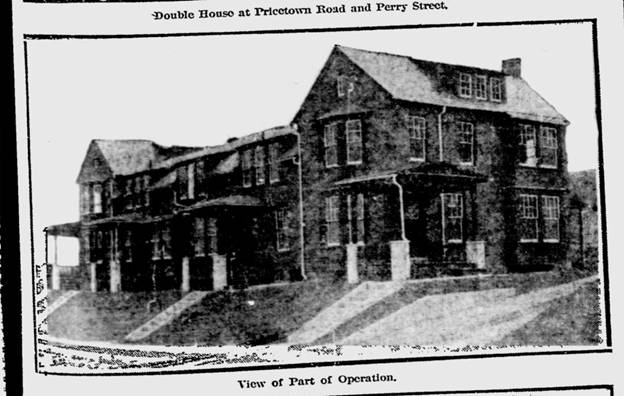
Early in March 1914, Muhlenberg Brothers
awarded a contract for twelve houses along the Pricetown Road
between Perry and Pike Streets to Charles H. Schlegel, of Mt. Penn.
Schlegel came from an old-line Berks family who traced their roots
to the early 1700s. Charles had left school early to work on his
father’s farm but decided that farming life did not suit him and
when Levi Focht, a contractor Reading, offered a job as a carpenters
apprentice, he took it. In 1903, when he was thirty one years old,
he built his first home as an independent contractor and never
looked back. Schlegel, whose primary business was commercial
construction, was a builder they knew well and trusted but building
small single family homes was not his forte. The Muhlenberg brothers
understood this and realized that eventually they would have to find
a builder who had the time and the motivation to devote full
attention to the job. They began to look for another developer.
Their search ended when they were called on by Samuel Sherman who,
like Schlegel, was another carpenter turned builder.
Sherman took a partner, David E. Houck during
the summer of 1912 and started a small company constructing homes in
the city. The two men built several rows of homes; one in the area
of Front and Spring and another opposite the Reading Hospital. But
Sherman, a man with boundless energy and ambition, realized that his
future as a builder depended on his ability to purchase land in
Hampden Heights but all their funds were tied up in the Reading
Hospital homes. At this point Sherman approached the estate with a
proposal. He would trade the six completed homes he owned near the
Reading Hospital for 5 tracts totaling about 7 acres on the north
side of Perry Street. The estate accepted his offer in the spring of
1915 and Sherman now had a foothold on the land that would make him
a rich man.
The informal partnership between Sherman, the
Muhlenberg Estate and Luppold & Whitman opened new opportunities for
the Sherman and Hock. They now had the support of two influential
groups who had close connections with the local banks. This enabled
them to buy a hundred building lots fronting on Pricetown Road
between Pike and Union. To keep up with the steady stream of buyers,
Sherman ran open houses seven days a week from morning to early
evening and by the end of the year Hampden Heights was the fastest
growing area in the county. An optimistic press reported that,
“Reading’s housing shortage may be resolved.”
Sidewalk superintendents and whole families
came to Hampden Heights to watch as forestland and pastures were
scraped down to the bare soil. In the dirt streets laid out in the
familiar grid style, sewer and gas lines were dug. A large sawmill,
built on the spot, cut old growth trees into lumber. And somewhere
in the middle of it all, Sherman did what he did best-sell homes.
Even America’s entry into the war didn’t stop
the progress, at least for a year, but then the scarcity and high
cost of labor began to cause problems. Soon after, restrictions on
the use of lumber and other vital materials brought new construction
to a stop. That situation lasted until the fall of 1919 when the
government released vast quantities of lumber and contractors began
to push ahead with new home building.
By 1920, Sherman, now operating without Houck
who returned to his father’s business as president of Merchants Ice
Company, and George Horst had built 140 homes at Hampden Heights.
Sherman used some of his hard-earned money to build a spacious home
for his family closer to his work on a corner property at 1400
Hampden Boulevard.
The year 1923 marked the greatest period of
industrial expansion in Reading’s history. Four thousand new jobs
were created that year and the new workers needed a place to live.
Although there were 237 new residences added to the tax rolls the
prior year, it was still not enough to satisfy the demand.
Across the river, the Wyomissing Development
Company was formed to house an influx of new workers in the textile
factories and had plans to build nearly 200 homes that year.
The growth of the northeast section brought
about the need for new municipal services. Besides streets, curbing,
water, gas, and electric lines, new schools had to be built.
Northeast Junior High, opened in 1923 with a capacity of 1,200
students, was designed and built to be the most modern building in
the county. On the rooftop was located an “open-air school, in rooms
flooded with fresh air and sunshine” designed for “children who are
anemic and who have a predisposition to tuberculosis” Even with this
addition to the system, the school district still had a hard time
keeping up with the enrolment growth.
In June, 1923 the board of education agreed on
a plan to close 10th and Union, 11th and Pike,
and 9th and Marion and construct a new elementary school
at 13th and Union. But that project, designed by
Muhlenberg Brothers, was not scheduled to open until the school year
of 1929.
Trolley lines, still the primary mode of
transportation, were being laid during 1924 and over 150 homes were
in various stages of construction along 12th and Union
Streets; all of them by Hampden Heights Real Estate Company, now
under the exclusive control of Sam Sherman. The following year was
even better; Sherman had 112 homes under construction or sold during
the first 10 months of the year and permits for the construction of
a total of 426 new homes. The vacant space between 13th
Street and Hampden Boulevard was rapidly filling in with new houses.
In order to provide a wide range of prices as
well as simplify construction, Sherman was marketing from a plan
book in which house styles were identified by a number. For
instance, the best selling number 109 priced at $6, 350 contained
“six rooms, one bath, French doors, cement cellar, electricity, gas,
hot air heat, abundant shrubbery and a 20 foot lot. The No. 4 Plan
was “built on a square plan and is noted for its 24 foot living
room. 30 foot lot.” Erected in brick or stone it contained 4
bedrooms and was priced at $9,250. A less expensive one was located
at 1323 Linden was called “ one of the most modern and complete
being offered for sale.” The floor design was what he called “the
square-type plan” and offered it at a selling price of $8,300.This
system proved very efficient since foremen could readily access
their plan books which listed all the materials required for
construction. As a result, there was little waste since Sherman knew
at all times exactly the amount of materials he needed. In addition,
since the workers were accustomed to building each particular style,
mistakes and construction were minimized. Operating seven days a
week, five of them until eight o’clock at night Sherman could be
found in his office at 11th and Perry Street office.
Several other smaller builders were now active
in the Hampden Heights area. Aulay P. Tompkins who lived on
Freidensburg Road in Mt. Penn built several homes in the 1600 block
on N. 15th Street including several at the corner of 15th
and Union that he advertised for sale in 1926: “English Style single
homes, with handsome garages. Hampden Heights grandest suburb, yet
in the city, where you have the great advantage of sewers. NE
trolley will carry you to the homes. Apply 1412 N 14th
Street.”
Thus far virtually all building activity was
located on the lower side of Hampden Boulevard. That situation began
to change when George Horst filed preliminary plans for a large
subdivision extending above Hampden Boulevard to Oak Lane. Horst was
one of the half dozen large landowners in the city. As the owner of
Reading Hardware Company and the Nolde-Horst Hosery, he had invested
in acreage surrounding the city which included large tracts on Mt.
Penn. The Gravity Railroad for example was built on land he sold and
donated to the city.
In 1922 Horst purchased most of Hampden Heights
above the boulevard from the Hampden Heights Development Company for
$7,308.09 in cash. In addition, he agreed to assume the balance of
the $170,000 mortgage due to the estate of Nicholas Muhlenberg,
which amounted to about $130,700.
That same year he offered 10 acres of Hampden
Heights above the boulevard to the city at no cost. The only
provision was that the land, which was mostly farmland with a few
trees on it, be developed within five years as a park. The city
estimated their costs and turned down the offer. So he decided to
subdivide the lots and sell them.
On Dec 6, 1927 his Hampden Heights subdivision
received final approval. This plan, intended to attract the more
affluent buyer, was laid out on much larger parcels than the lots
below the boulevard. Here the buyers could choose their own
architect and builder and consequentially construction commenced in
a far more leisurely manner.
Meanwhile Sherman moved forward with his
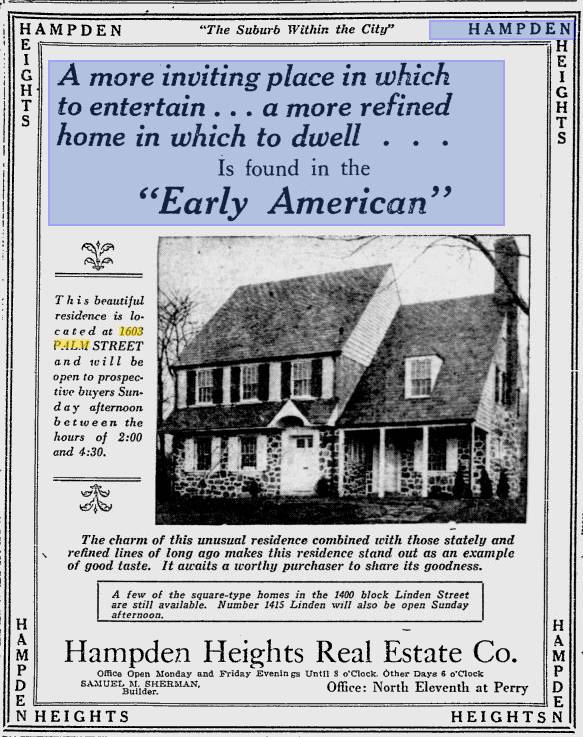
construction and in 1928 offered several homes for sale in the 1600
block of Palm Street. He described the architectural style of these
single homes as an “Unusual tone of ‘Early American’”. There was no
mention of the fact that the construction had been done by Horst and
that they had been designed by the architect Miles Dechant. Dechant
had approached Horst with plans to build homes that he believed
would test his dream of designing homes that would break with the
traditions of the past.
Miles Boyer Dechant had a reputation for
imaginative architectural design and his work could be seen in
public structures such as the old county court house and the band
shell in City Park, private homes and churches throughout the
county. His father’s firm had survived in the shadow of other firms
due in part to a lack of financial and political acumen. During 1928
while working on designing a remodeling plan for St. Paul’s Memorial
Reformed Church, Miles wrote an article for The American Architect
titled Eight Houses for the Hampden Heights Development Company.
In that article he commented on the recent lack of “good taste and
correct design” of homes built by development companies. “The old
scheme of row upon row of monotonous mid-Victorian type of city
house polluted the minds of the public; it has seen its day and
thank goodness it shall never return.” His inspiration for a new
type of city home came to him while stationed in France during World
War I during which he spent time away from his base traveling
throughout the countryside sketching and painting the modest homes
he saw. “My wishes have come true”, he wrote in a letter home, “and
as I looked upon this beautiful and humble domestic architecture of
the peasants, my ideals as an artist were realized.”
In the 1928 article, he tells us that these
homes built on Palm Street were his attempt at beginning a
“Renaissance in the architecture of the small house.” “These homes”,
he wrote, “simply portray American thought expressed in
architectural motives that are English and Colonial.” They are
“modern houses, with a touch of individuality.” All of these homes
would, Dechant stated, be affordable to families of “moderate
means”. When new, their cost would not exceed $18,000, the
equivalent of about $225,000 today. He predicted that, “The houses
of fifty years hence shall be models of architectural beauty. I can
see the future suburban districts of our cities beautifully and
wonderfully laid out with homes comparable with the smaller manor
homes of France, Italy and England.”
Stevens Residence Hessian Camp
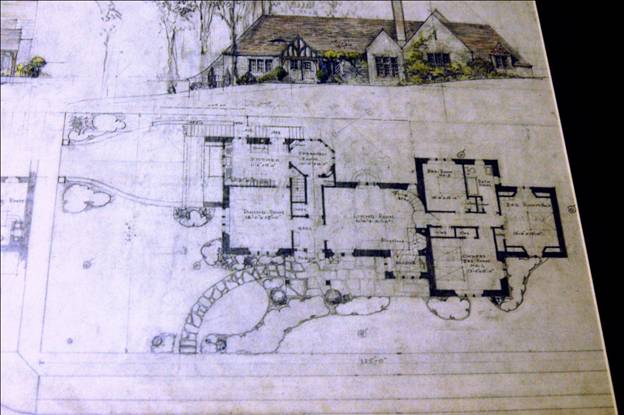
Weidner Home-Alsace Road SEQ
Weidner_Home-Alsace_Road \* ARABIC 1
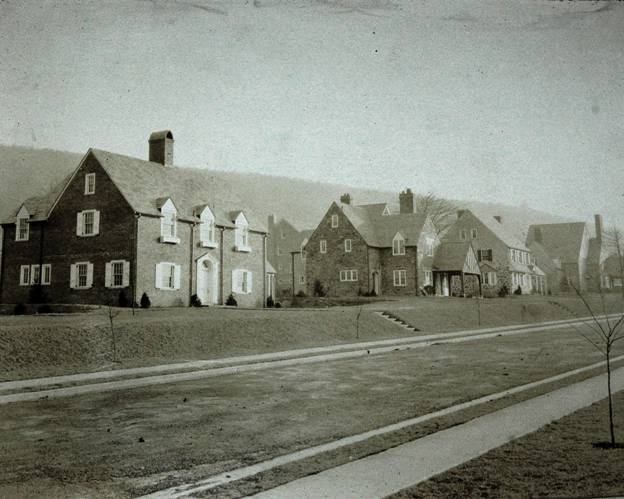
1600 Block Palm Street SEQ
1600_Block_Palm_Street_ \* ARABIC 1
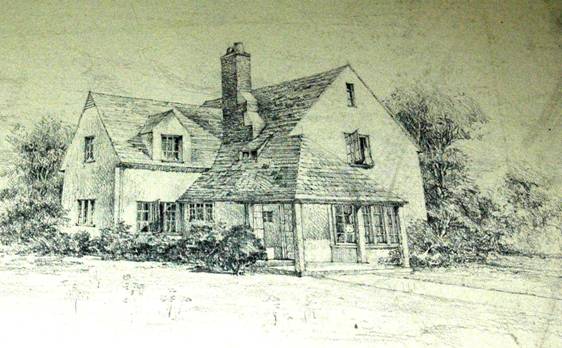 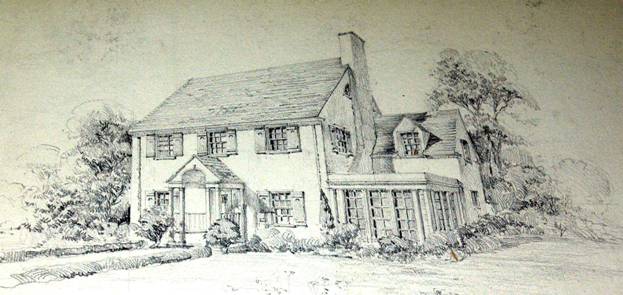
Homes entered in Small Home Competition SEQ
Homes_entered_in_Small_Home_Competition \* ARABIC 1
Although all the Dechant homes sold, his dream
of creating sparking a Renaissance in design were not fulfilled. The
hunger of the public for smaller cheaper housing and of builders for
greater profit won the day.
Another fine architect, John C. Dethoff,
designed and built the first church in the area, The Lutheran Church
of the Nativity, on the northeast corner of 13th and
Amity streets in 1928.
Aulay P. Tompkins continued his small project
on North 15th Street and sold one of his attached homes
at 1606 for $13,800 to the First Reformed Church for use as a
parsonage.
George Horst was active in the 1700 block of
Olive, the 1500 block of Alsace Road and Bern Street. He built 1501,
1605, 1607, and 1715 and 1600 Hampden Boulevard as well as 1500
Lorraine, while Samuel M. Sherman started construction on a two
story home at 1415 Hampden Boulevard.
Throughout 1929 competition was keen as new
builders entered the area. Shuman Realty Co. had 20 homes for sale
in the 1200 block of Alsace Road for $9,500. Sixteen of them sold
before the sample house was completed. His advertisements stated
that this was “the first time houses of this character have been
offered at Hampden Heights at this low price.” They were a good
bargain, they were set back 8 feet from the street, sewer connected,
and had shade trees and a detached garage. D. F. Haupt, a builder
located at 229 N. 6th St. offered a home at 1508 Alsace
Road with a 68 foot lot 4 bed rooms, tile bath, hot water heat and
every modern convenience. And Thomas Davis was offering private
financing on his properties in the 1700 block of Olive Street. All
but two of them sold within a few months.
Construction began that year on the on the
spectacular Bitting mansion at 1711 Hampden Boulevard. George Horst
sold the square block of cleared land to William Bitting who owned
Rosedale Knitting, the third largest hosier in the county, in late
December and construction began in the spring of 1930. The sale of
the land for $65,000 enabled Horst to clear about half of the
mortgage owed to the Muhlenberg estate.
That summer Sherman was offering another
“American Colonial”; this one at 1611 Palm Street. In his
advertisement he said, “The above home expresses the charming
architecture of the “Colonial” period. It is most modern in its
layout and contains two tiled baths with showers and 4 bedrooms.
Thirty four other properties are under construction and may have
already been sold.”

By 1930 nearly 900 homes had been constructed,
but sales of his completed homes began to slow. Sherman and others
had continued to build despite the fact that the stock market had
crashed in October 1929. The bills began to pile up. There were
taxes to pay, improvements to be financed, and interest accumulating
on loans he used to buy everything from land to construction labor.
Believing that the depression was merely a temporary setback,
Sherman was determined to stay afloat by employing tactics which he
later came to regret.
Credit for mortgages was difficult to come by
and banks were demanding that homebuyers put down a greater amount
of cash; as much as 40 percent. To overcome this obstacle, Sherman
used his own funds to provide second mortgages to cash poor buyers.
At one point he had well over a half million dollars lent out.
Sherman began to borrow using his unsold homes as collateral,
figuring that he could repay these loans when the house sold. But
they didn’t sell.
Most businessmen would have given up long
before they risked their personal fortune but Sherman wasn’t by
nature a businessman, he was a salesman and an optimist. That’s why
he got where he was, that’s why he fell.
In 1933, Sherman had 125 properties in
foreclosure and had lost $545,000 in failed second mortgages he had
given to induce people to buy. In addition, he owed mortgages of
almost one million dollars, and had liens and other debts of about
$700,000. Even his $400,000 life insurance had been pledged as
collateral. In total he owed over 2.3 million dollars. He was
bankrupt but still he didn’t give up. Rather than immediately
seeking a legal remedy, bankruptcy, he had spent his personal
fortune. When he finally declared bankruptcy on June 27, it was too
late. He had already bent or broken too many laws in his effort to
stay afloat.
In the end he was undone by a widow named
Barbara Silvis. She had bought a home from Sherman for $14,000.
Sherman took title to her former residence as a down payment and
Mrs. Silvis paid the balance in cash using all the money she had
left from her husband’s estate. What Sherman failed to tell the
widow was that he had used her house as collateral for an $8,000
loan. Mrs. Silva thought that her home was paid for when, several
months later, she was served foreclosure papers from the bank for
the unpaid $8,000 mortgage. She sued Sherman and the case went to
court.
On April 10th, 1935 Sherman failed
to appear in court to answer her complaint and a warrant was issued
for his arrest. He was found sleeping in his car which was parked
near the Spring Street viaduct. In July the court offered him a
hearing to seek protection under the insolvency laws which could
protect him from going to jail for his debts. While this was going
on, Ada and Mary Deibert who had bought a home at 1427 Palm Street
came forward with an additional charge. Like Mrs. Silva, they had
purchased the home for $10,000 only to find that there was another
mortgage on the home for $5,400. They brought suit and won. Other,
similar suits were threatened.
In October, Samuel M. Sherman “dejected and
worn by the strain of a long fight to escape imprisonment” was sent
to jail. He was found guilty under an obscure law from1842 which
provided that a debtor can be imprisoned indefinitely until he pays
his debt. He had the distinction of being the first person
prosecuted under this law in 20 years. While imprisoned for three
months, Sherman worked at the one job he knew well, carpentry.
In December of 1935, Ms. Silvis lost her home.
While in Berks County Prison, Sherman was
allowed a one day release to attend the funeral of his wife who died
in December of 1935. He was released from prison in January 1936.
True to form and ever the optimist, Sherman appeared before the
County Commissioners shortly after his release and offered his
services as a contractor to improve the facilities at the Berks
County jail. He didn’t get the job. But he continued working for the
next two decades as president of the Hampden Heights Real Estate
company. He died on January 21, 1956.
The 1930s witnessed an increased interest in
new methods of home building and home financing.
President Roosevelt established
the Federal Housing Administration in 1934 as a way to stimulate
home buying by offering lower cost home loans. The new F.H.A. loan
reduced down payment requirements and interest rates and also
extended repayment terms to thirty years.
The net effect of this program was that it
dramatically reduced the cost of home ownership and at the same time
it established new standards of building by requiring that each
F.H.A. financed home meet newly established building standards.
Frederick P. Behm, a local contractor, was
one of the first to take advantage of FHA financing. In 1936 he
built a model home at 16th and Bern Streets “as a
demonstration of how the uses of modern and durable materials
...provide quality construction at average costs.” Richter & Eiler,
the Reading firm that designed Reading High School, designed the
home.
Robert Jepsen built three homes in 1937 two
on Olive Street at 1813 and 1817 and one at 1209 Lorraine Road. His
advertisements too promoted the use of “modern materials”. “Built
to Type C Reynolds Specifications providing healthful,
comfort-giving conditioned air. This was a house completely
insulated with Metallation a ‘steel reinforced’ insulation product
introduced by Reynolds Corporation.
Another local builder, John C. Dethoff built
home at 1804 Olive Street that had a tile roof, unusual for the
area. He also 
highlighted the use of insulation inclusion of
“automatic hot water heater”.
Up the hill, the Horst development was running
into problems. George Horst had died in 1934 and his estate was
having trouble handling the costs of taxes and costs of development.
There were still 65 unsold lots and taxes amounting to $14,000
annually. Their solution was to “sell” the lots to a dummy
corporation known as the Forest Hills Corporation but problems with
taxes would continue to plague them into the mid-1940s.

North East Reading Circa 1942 SEQ
North_East_Reading_Circa_1942 \* ARABIC 1
The Heights area continued to grow until it met
the city limits. Just over the borderline, a new development was
started in August, 1947 when plans were filed for the College
Heights subdivision in Muhlenberg Township and by November, lots
were offered for sale by Davis & Sons, local realtors.
Building in the area continued until well into
the 1960s especially in the new “College Heights” area. But, no
longer was there a domination of one or two builders or sales
agents. Homes were designed and built by a larger variety of
contractors and new styles of homes that emphasized convenience and
economy over architectural harmony were thrown into the mix.
These homes emphasized the inclusion of “modern
conveniences” and were built utilizing new materials such as
fiberglass insulation, brick veneers and electric heating. The
all-electric “Ready Kilowatt” home at 1947 North 15th
Street built in 1953 is a good example.

This type of home was more suited to the needs
of family of the 50s rather than the family of the 20s or 30s. The
number of married women in the workforce had more than tripled since
the twenties and these women welcomed the “convenience oriented”
style of the ranch house; the one floor plan that eliminated the
stairs to the bedroom area, the addition of larger closets, kitchens
that included built in appliances and had more cabinet space. By the
1950s, the ranch house with its minimal use of exterior and interior
decoration accounted for nine out of every ten new houses
nationwide.
Despite this national trend, the variety of
architectural styles and price ranges was continued in this new
area.
The Heights district represents one of the very
few areas in the city which is still occupied predominantly by a
mixture of middle and upper-middle class families. Its rich mixture
of architectural design is unique to the city. The well kept homes,
tree lined streets, accessibility to schools and shopping, and open
spaces for play are not so much a relic of the past as a plan for
the future. But the area is constantly threatened by the desire of
investors seeking the cash flow stemming from the conversion of
single-family homes into multi-unit rentals and of businesses
looking to capture the dollars spent by college students. If the
Heights is to survive as an example of a “garden city plan” steps
must be taken to insure that the vision of the original planners is
maintained. Maintaining the architectural heritage of the area is
but one step in that process.
|